
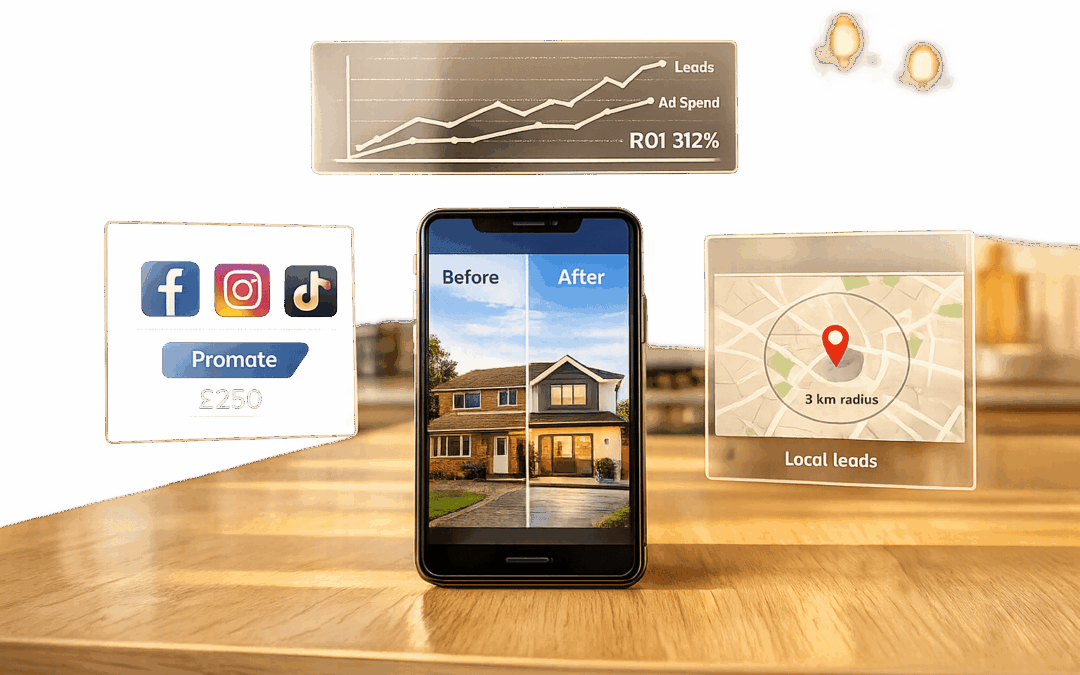
Social media is a game-changer for home improvement businesses. Platforms like Facebook, Instagram, and TikTok help contractors showcase their work, attract local clients, and build trust with potential customers. With 78% of homeowners influenced by social media when choosing contractors, having a strong presence is no longer optional.
Here’s the key to success:
- Choose the right platforms: Facebook works well for local homeowners, Instagram for visuals, and TikTok for quick, engaging clips.
- Create engaging content: Share before-and-after photos, client testimonials, and behind-the-scenes clips to build credibility.
- Leverage paid ads: Use targeted campaigns to reach homeowners in your area and generate immediate leads.
- Track performance: Focus on metrics like leads, clicks, and conversions to refine your strategy.
Start small by focusing on 2–3 platforms, post consistently, and align your content with what homeowners want to see. Whether it’s a kitchen remodel or a new bathroom, social media can turn your projects into a lead-generating machine.
The Social Media Strategy That Brings Contractor Leads Without Wasting Ad Spend with Jen McKee
sbb-itb-28d1bc6
Choosing the Right Social Media Platforms for Your Home Improvement Business
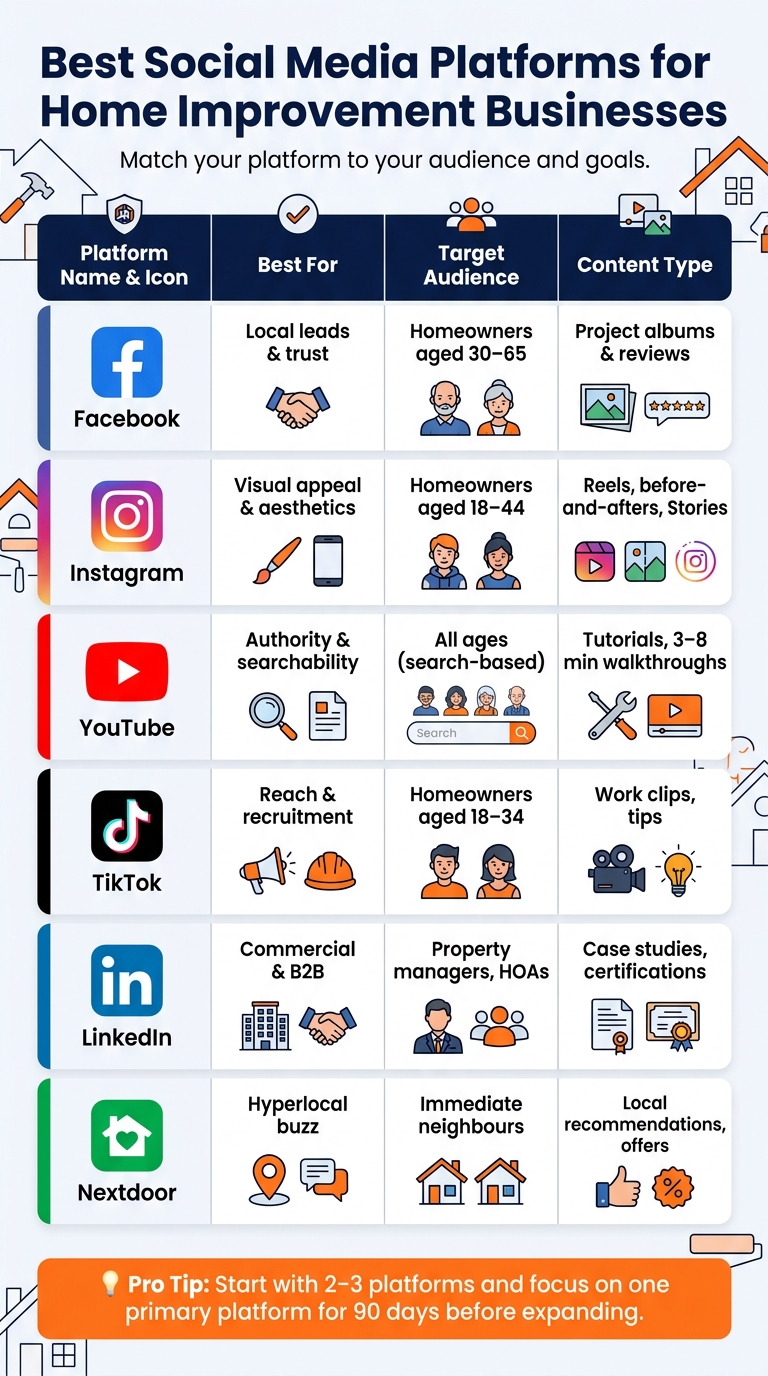
Social Media Platforms for Home Improvement Businesses: Which One Is Right for You?
A Look at the Main Platforms
Each social media platform has its strengths. Knowing these can help you focus your efforts where they’ll make the biggest impact.
Facebook remains one of the top choices for connecting with local homeowners. Its community groups and review features are perfect for building trust, especially with the 30–65 age group. In fact, 79% of online adults aged 30–49 are active on the platform. Meanwhile, Instagram is ideal for showcasing visually appealing content. With its younger audience (18–44), it’s the perfect place to share before-and-after transformations and highlight projects through Reels.
For businesses looking to establish long-term visibility, YouTube is a strong contender. As the second-largest search engine, it attracts homeowners who are actively researching solutions, making them more likely to convert into leads. On the other hand, TikTok is a great platform for reaching younger audiences or growing your brand quickly. Short, satisfying work clips often perform well here, driving organic reach. If your business focuses on commercial work, LinkedIn is the go-to platform. It connects you with property managers, homeowners’ associations (HOAs), and facility directors.
For hyperlocal engagement, Nextdoor is worth exploring. It allows you to connect with immediate neighbours through local recommendations and offers.
| Platform | Best For | Target Audience | Content Type |
|---|---|---|---|
| Local leads & trust | Homeowners 30–65 | Project albums & reviews | |
| Visual appeal & aesthetics | Homeowners 18–44 | Reels, before-and-afters, Stories | |
| YouTube | Authority & searchability | All ages (search-based) | Tutorials, 3–8 min walkthroughs |
| TikTok | Reach & recruitment | Homeowners 18–34 | Work clips, tips |
| Commercial & B2B | Property managers, HOAs | Case studies, certifications | |
| Nextdoor | Hyperlocal buzz | Immediate neighbours | Local recommendations, offers |
Understanding these platforms is the first step. The next is aligning them with your business objectives.
How to Pick the Platforms That Match Your Goals
Start by defining your target audience – think about their age, location, and specific needs. Then, choose platforms that align with these factors.
For residential work, Facebook and Instagram are likely to cover most of your audience. If your focus is on commercial contracts, LinkedIn should take priority. However, trying to manage too many platforms at once can spread your resources too thin. Experts suggest focusing on one primary platform for 90 days before adding another.
"Social media is the ultimate equaliser. It gives a voice and a platform to anyone willing to engage." – Amy Jo Martin, Author
A good rule of thumb? Start with two or three platforms that align with your goals. Post consistently, build a rhythm, and only expand once you’ve established a strong presence. Trying to do it all at once often leads to doing none of it effectively.
Building a Social Media Content Plan for Home Improvement Companies
With your platforms chosen, the next step is creating a content plan that turns viewers into leads.
Content Formats That Get Results
Once you’ve selected your platforms, the focus shifts to identifying content formats that effectively convert interest into action.
Before-and-after visuals are a must. These instantly build trust by showing clear results: the problem, the solution, and the transformation. Posts featuring original project images can boost engagement by 67% and triple your chances of conversion. This makes showcasing your actual work essential for success.
Educational posts are just as important, especially for homeowners who aren’t quite ready to hire. Content that explains material options, highlights common pitfalls, or outlines project timelines positions your business as an authority. Meanwhile, behind-the-scenes content – like demolition day clips or site cleanup videos – adds a personal touch, easing the concerns many homeowners have about tradespeople working in their homes.
| Content Format | Primary Goal | Best Platform |
|---|---|---|
| Before-and-After | Build trust and conversions | Instagram, Facebook |
| Behind-the-Scenes | Humanise your brand | Instagram Stories, TikTok |
| Quick Tips / How-To | Establish authority | Pinterest, YouTube, Facebook |
| Client Testimonials | Reduce hiring hesitation | Facebook, Instagram |
| Interactive Polls | Drive engagement | Instagram Stories, Facebook |
Stick to the 70/20/10 rule for content: 70% should provide value, 20% should focus on community, and 10% can promote your services. This balance ensures your feed remains helpful rather than overly sales-focused.
Next, align your content formats with the different stages of a renovation project to guide potential clients seamlessly through their decision-making process.
Aligning Content With Project Stages
Crafting content that mirrors the stages of a project helps create a cohesive narrative for homeowners, taking them from inspiration to action.
During the inspiration and planning phase, focus on high-quality photos, trend updates, and educational posts about budgeting or material choices. This is when most homeowners are browsing for ideas – around 75% of consumers use social media for inspiration before committing to a home improvement purchase.
When the project is underway, shift to behind-the-scenes content. Share demolition clips, progress updates, and brief explanations of the work being done. Finally, at the completion stage, it’s time for the big reveal. Use a before-and-after carousel or a short walkthrough video (30–60 seconds) to showcase the results. After the project ends, client testimonials and review quotes give your work lasting impact and provide social proof for potential clients. As GYRO (Grow Your Remodel Outfit) explains:
"Social media does not need to be loud or constant to work. Remodelers win when they show steady proof of craftsmanship, communicate a clear process, and stay visible in the places homeowners already scroll."
One renovation can easily fuel a week’s worth of posts: a before-and-after carousel, a post about key decisions made during the project, a process video, a budgeting tip, and a client testimonial.
How Often and When to Post
Once your content is mapped to project milestones, the next step is determining a posting schedule that keeps your audience engaged.
Consistency is more important than frequency. A manageable schedule that you can sustain over time will always outperform a short-lived burst of daily posts.
For platforms like Facebook and Instagram, aim for three to five posts per week, complemented by daily or near-daily Stories when you’re on-site. On TikTok, two to four short videos per week work well, while LinkedIn only requires one to two posts weekly if your focus is on commercial clients. Prioritise video content – it drives 1,200% more shares than text and images combined.
"The single most important strategy in content marketing today is video." – Gary Vaynerchuk, CEO of VaynerMedia
To save time and maintain consistency, batch your content creation and schedule posts in advance. Always tag your local area in posts to boost visibility among nearby homeowners.
Using Paid Social Media Ads to Generate Leads
A solid content strategy helps build trust over time, but relying solely on organic reach has its limits. For local businesses, organic posts now reach fewer than 2% of followers. Paid ads, on the other hand, can instantly connect your projects with targeted local homeowners. This method fills the gap left by organic efforts and generates immediate leads.
What Paid Social Campaigns Can Do for You
Paid social ads deliver measurable results. For example, Facebook Ads in the home improvement sector boast an average 9.21% conversion rate, and nearly 30% of consumers have supported a small business after seeing their ad on Facebook. Unlike organic posts, paid campaigns allow you to control who sees your content, offering a level of precision that organic methods simply can’t match.
| Feature | Organic Social Media | Paid Social Media Ads |
|---|---|---|
| Reach | Under 2% of followers | Broad reach across specific local areas |
| Speed | Slow; builds over time | Immediate lead flow |
| Targeting | General audience | Specific to zip codes, income, and homeownership |
| Cost | Free (but time-intensive) | Requires daily ad spend |
| Primary Goal | Building trust and awareness | Direct lead generation |
How to Set Up a Campaign That Works
If you’ve already built an organic content portfolio, you can enhance it with paid ads – but you’ll need proper tracking to measure results. Before launching any campaigns, install the Meta Pixel and Conversion API on your website. Without these tools, you’re essentially guessing at what’s working, as you won’t be able to track enquiries or bookings effectively.
"The biggest mistake local businesses make is launching ads without conversion tracking in place. You end up spending money with no way to know what is working." – City Web Company
Set your campaign objective to "Lead Generation" and take advantage of Meta’s instant forms, which allow you to capture leads without users leaving the platform.
"Facebook lead ads have become our go-to recommendation for contractors because they capture contact info without users leaving the platform." – Alex Mallin, PPC Specialist, Improve & Grow
To ensure quality leads, include two or three qualifying questions in your lead form. Ask about project timelines, budget ranges, or homeownership status to filter out less serious enquiries. Use visuals like real project photos or short videos (30–60 seconds) and include trust signals such as five-star reviews or trade licences in your ad copy. Start with a budget of £500–£1,000 per month to give the algorithm enough data to optimise, and plan for a daily testing spend of £20–£50 during the first two weeks. Run A/B tests on your headlines and visuals for at least seven days before making decisions. To ensure quick follow-up, connect your lead forms to a CRM using tools like Zapier so you receive instant notifications.
Once your campaign is running, focus on refining your targeting to attract high-quality local leads.
Targeting Local Customers With Paid Ads
For local businesses, precise targeting is essential. Set a 15–30 mile radius around your service area and apply demographic filters, such as homeowners aged 30–65, with household incomes above £75,000, and interests in home renovation, DIY projects, or interior design. This ensures your budget isn’t wasted on renters or people outside your service area.
Target groups like "New Homeowners" or recent movers, as they’re more likely to invest in home improvements. Seasonal offers can also be effective – for instance, promoting gutter cleaning services before autumn or heating system checks before winter. Make your ads feel local by mentioning specific towns or neighbourhoods in your copy. For example, "This Sheffield kitchen was completely transformed in just two weeks" builds immediate relevance.
When allocating your budget, divide it strategically: 40–50% for retargeting past website visitors or social media engagers, 25–30% for lookalike audiences based on your existing customer data, and 20–25% for cold local prospecting. Remember, timing is critical – leads contacted within five minutes are 21 times more likely to convert than those followed up after 30 minutes. Automate your responses with text notifications to ensure you don’t miss out on potential customers.
Tracking and Improving Your Social Media Results
Running campaigns without tracking their performance is, as Shannon Donovan, Founder and President of Remodelers Marketing Crew, aptly describes:
"Marketing without data is like remodeling a kitchen without blueprints. You might end up with something decent, but it won’t be efficient or scalable."
Once your campaigns are live, it’s time to focus on the metrics that matter and how to use that data to fine-tune your approach.
The Metrics That Matter
Not all metrics are created equal. While reach and impressions can tell you how many local homeowners are seeing your content, they don’t necessarily reflect genuine interest. To measure intent, prioritise metrics like saves and shares – these indicate that potential customers find your content valuable enough to bookmark or recommend.
Beyond engagement, track actionable metrics like website clicks, profile taps (e.g., "Call" or "Directions" buttons on Instagram and Facebook), and lead form submissions. These help bridge the gap between casual interest and active enquiries. For paid campaigns, keep an eye on your Cost Per Lead (CPL). In the kitchen remodelling niche, a CPL of around £160 is considered efficient, given the high value of these projects.
| Funnel Stage | Key Metrics | What It Tells You |
|---|---|---|
| Attention | Reach, Impressions, Video Views | Whether local homeowners are discovering your brand |
| Interest | Saves, Shares, Comments, DMs | Whether homeowners are considering your services |
| Action | Website Clicks, Profile Taps | How effectively your calls-to-action convert interest into enquiries |
| Conversion | Consult Requests, Form Fills, Booked Estimates | The tangible results of your social media efforts |
Once you’ve gathered this data, the next step is understanding what it means and how to act on it.
Interpreting Your Performance Data
Metrics can tell a story – if you know how to read them. For instance, high impressions but low engagement suggest your content isn’t resonating. Similarly, a high click-through rate (CTR) paired with a high bounce rate might mean there’s a mismatch between your post and the landing page it leads to.
Using UTM parameters can help you accurately track where your enquiries are coming from and which campaigns are driving results.
"A like doesn’t necessarily mean someone is interested in your services… Vanity metrics rarely indicate whether your social media efforts are driving inquiries or sales." – Construction Digital Marketing
By digging into these insights, you can refine your strategy to focus on what truly works.
Adjusting Your Strategy Based on Data
Once you understand your metrics, use that knowledge to optimise your campaigns. Review your top three posts each month, focusing on saves and shares rather than likes. This can help you identify what content resonates most with your audience. For example, if before-and-after photos consistently outperform other posts, consider creating more of that type of content.
If you’re seeing strong social traffic but few consultation bookings, it might be time to simplify your contact form or try a different call-to-action. Swapping "Contact Us" for something more specific like "Get a Free Estimate" can often improve conversion rates. And if your CPL starts climbing, narrow your audience targeting by factors like household income or property value to bring costs back down.
Tools like Meta Business Suite can help you schedule posts and track engagement trends, while Google Analytics provides insights into post-click behaviour. Pair these with a CRM system like HubSpot or Salesforce to connect social media leads directly to signed contracts, giving you a complete picture of your campaign’s effectiveness.
Conclusion: Next Steps for Your Home Improvement Social Media Strategy
Building a strong social media presence takes time, but the payoff can be well worth the effort. As Carl Lefever, Founder of Improve & Grow, explains:
"If you’re not using social media to market your business, you’re missing potential prospects that may be in need of your services."
Consider this: a landscape designer increased website traffic by 55% and leads by 90% using hyper-local targeting, while a roofing company boosted its leads by an impressive 340%. Both achieved these results by applying the strategies outlined in this guide.
Here’s a quick action plan to get started: focus on the platforms your audience prefers, showcase real projects in your content, and use geo-targeted paid campaigns to attract local leads. Track key metrics like cost per lead, consultation requests, and signed contracts to measure your success.
Stick to a posting schedule of three to five times per week and conduct monthly reviews to refine your approach. By staying consistent, you can turn your social media efforts into a steady source of leads.
Need help bringing this strategy to life? Flex Digital specialises in creating tailored social media strategies for home improvement businesses, helping you generate real enquiries that drive results.
FAQs
Which 2–3 social platforms should I start with?
When choosing where to focus your social media efforts, it’s smart to concentrate on 2–3 platforms where your target audience is most active. For many home improvement businesses, Facebook works well for connecting with local communities and building relationships. Instagram stands out for sharing visually appealing before-and-after projects.
Depending on your goals, you might also explore Pinterest, which attracts homeowners looking for inspiration and planning ideas, or TikTok, ideal for engaging with trends and creating short, attention-grabbing videos. The key is to pick platforms that resonate with your audience and fit the type of content you create.
What should I post to get more local leads?
If you’re looking to connect with local homeowners, the key is sharing engaging, trustworthy content that highlights your expertise. Think about posting before-and-after photos of your projects – these offer a visual way to showcase your skills. Add in client testimonials to build credibility and trust.
You can also share helpful tips, such as advice on home maintenance or the latest design trends, to position yourself as a go-to expert in your area. And don’t forget: every piece of content should include a clear call-to-action. Whether it’s encouraging people to request a quote or schedule a consultation, make it easy for them to take the next step.
How do I track social media leads properly?
To stay on top of social media leads, tie your posts to measurable actions – like clicks, form submissions, calls, or consultation requests. It’s smart to focus on a single main goal each month. Use the built-in analytics tools on platforms to track engagement metrics like saves, shares, and messages.
For website traffic, UTM parameters are a great way to pinpoint which content is driving results. Keep things organised with a straightforward spreadsheet or a CRM system to tag leads by their source. Review your progress every month to fine-tune your approach and see what’s working best.